ASL - Sign Language.learn ASL!
- 4.7
- Rating
- 100.00K
- Installs
- Free
- Price
 Analysis by App-foxy
Learning American Sign Language can feel intimidating at first because the challenge is not only remembering vocabulary. You also need to notice hand position, movement, facial expression, and the difference between a sign that looks almost right and one that communicates something else. ASL - Sign Language.learn ASL! is an education app built around that first step: helping beginners become familiar with the language used by Deaf and hard-of-hearing communities. I found its main appeal in its approachable purpose. It gives a curious learner a place to begin without requiring a classroom, a partner, or a large study plan.
The app is free to install, and its content rating is Everyone, which makes it suitable for families, students, and adults who simply want to learn useful signs. It comes from Educational quizzes, and its current version is 1.14.28. The app has reached over 100 thousand installs and holds a 4.7 average from around 5 thousand ratings, so it has clearly attracted a sizeable audience. Those figures do not replace personal experience, but they do suggest that the basic learning idea is connecting with many users.
Starting with realistic expectations
I would not treat this as a complete replacement for an ASL class or for regular interaction with fluent signers. An app can introduce vocabulary and help you build a habit, but it cannot fully reproduce the visual feedback, natural conversation, cultural context, and correction you get from a teacher or Deaf community. That distinction matters because beginners can easily memorize an isolated sign while missing how it changes in a real exchange.
You May Also Like

 Blood Strike: 2.5 Anniversary
Blood Strike’s Loadouts Turn Every Drop Into a Tactical Gamble
A close look at Blood Strike’s custom loadouts: how fast access to signature weapons reshapes its battle royale rhythm, rewards preparation, and narrows the gap between fights.

 Pandora - Music & Podcasts
Pandora’s Music Is Easy to Start, but Harder to Recover
Pandora’s strength is its low-effort path from a seed to a station. Its weak spot is how much confidence it asks you to place in connection, setup, and quiet recovery.

 8 Ball Pool
 Is Built on Rivalries, Rematches, and Routine
A close look at the rivalries, rematches, shared routines, and unanswered safety questions that turn a quick pool match into a persistent mobile community.

 Samsung Music
’s Quiet Strength Is Playing What You Already Own
Its reach comes less from spectacle than from dependable access to a personal library. That simplicity is both the app’s strongest retention engine and its ceiling.

 AccuWeather: Weather Radar
AccuWeather Review: A Quick, Clear Forecast for Everyday Decisions
For everyday plans, the best forecast is the one you can understand quickly. AccuWeather makes rain timing, radar, and local conditions easy to act on, with a few trade-offs.

 Hill Climb Racing
Why Hill Climb Racing Still Turns Crashes Into One More Run
A tiny car, a bumpy hill and one more upgrade: Hill Climb Racing keeps resurfacing because its simple chaos makes every near-miss feel personal.
More From Our News Desk



What this app does well is lower the barrier to starting. Instead of waiting until you have time for a formal course, you can open it during a quiet moment and begin exploring. That is especially useful if your goal is modest and practical: learning greetings, communicating more comfortably with a Deaf acquaintance, supporting a family member, or deciding whether a longer ASL course is right for you.
The best mindset is to use each session as a small practice block rather than expecting fluency quickly. I found that the subject becomes less overwhelming when I focus on one group of signs at a time. Trying to absorb everything in one sitting makes visual details blur together, while short, repeated sessions give the hands and eyes more time to remember what they are seeing.
There is also an important difference between recognizing a sign and producing it. You may understand a demonstration immediately but struggle to reproduce the handshape or direction yourself. That is normal. I recommend watching a sign, pausing mentally, copying it slowly, and then checking the example again. The extra comparison is more useful than simply tapping through a long sequence of terms.
What the free starting point means
The free entry point makes experimentation easy. You can find out whether the presentation suits your learning style before committing money. At the same time, the app includes in-app purchases ranging from $19.99 to $99.99 per item. I would therefore avoid assuming that every part of the learning experience is included at no cost. Start with the free material, understand what you can access, and only consider a purchase if the app fits your routine and your goals.
That pricing range also changes who should approach the app cautiously. A casual learner may be perfectly satisfied with a limited introduction, while someone searching for a structured, long-term course should compare the paid option with local classes, teacher-led programs, or other ASL resources before spending. The most expensive choice is not automatically the best educational choice, particularly when personal feedback is important.
Setting up a useful first session
Installation should be straightforward on a device running Android 7.0 or later. Once it is ready, I suggest resisting the urge to rush through every available lesson or quiz. First, decide why you are learning. “I want to know some signs” is a fine beginning, but a more concrete aim gives the app a job to do. For example, you might choose to learn a small set of greetings, family-related terms, or signs that could help in a particular daily situation.
Keep your first session somewhere with enough light and space to move your hands. A dim room or cramped position makes it harder to compare your own handshape with what you see on screen. If you are learning on a phone, place it where you can look at the example without constantly changing your posture. This sounds minor, but comfortable positioning reduces the temptation to skim.
I also recommend keeping a simple paper note or a private list of signs that need another look. Do not write down only the English word. Add a brief reminder about the detail that caused difficulty, such as the direction of movement or which hand was active. This turns a vague feeling of “I keep forgetting this one” into a specific practice target.
Because this is an app for visual language, the screen is part of the lesson rather than just a menu. Give yourself time to observe. Look at the starting position, the transition, and the ending position. Beginners often remember the broad shape but miss the movement between those points. Slowing down at the beginning can save time later.
How to make the first attempt meaningful
My preferred first-session routine is simple. I choose a small group of signs, view each example carefully, copy it several times, and then return to the ones that feel less natural. After that, I test myself without immediately looking at the answer. The purpose is not to achieve a perfect score; it is to discover which signs I can recognize and which ones still depend on visual prompting.
A useful trick is to practice both directions. First, look at a sign and recall its meaning. Then read the meaning and try to produce the sign. These are different skills. Many learners are surprised to discover that recognition is much stronger than recall from memory. Finding that gap early gives you a better plan than assuming you have mastered a word because it looked familiar on screen.
Another practical approach is to connect signs to a real moment in your day. If you are learning a greeting, imagine meeting someone at work or school. If you are learning a family term, picture the person you would use it with. This does not turn an app exercise into a full conversation, but it gives the movement a purpose and makes review less mechanical.
The first meaningful success is not finishing a lesson; it is remembering a sign later without the screen. I would count that as progress even if the movement is still slow. Once one sign survives outside the app, the learning process feels more concrete and you have a reason to return.
Where beginners can become confused
The most common confusion is treating ASL as signed English. It is a distinct language, not simply spoken English acted out with the hands. An introductory app can help you learn individual signs, but you still need to be careful about assuming that a list of English words automatically teaches ASL grammar or natural expression.
Another difficulty is that a single English word may not map neatly to one universal sign in every situation. Meaning, context, regional variation, and the relationship between people can affect how something is expressed. If you see a sign that seems to match a word, avoid using it mechanically in every sentence. Use the app as a starting point, then confirm broader usage through reliable educational sources or guidance from fluent signers.
Handshape is only one part of the picture. Orientation, location, movement, and facial expression can all matter. A learner who concentrates only on the fingers may miss the feature that makes the sign clear. I found it more productive to ask, “What changes from the beginning to the end?” rather than trying to freeze the hand into one still image.
Quizzes can create a second kind of confusion. A correct answer may show that you recognized a presented item, but it does not necessarily prove that you can sign it naturally. Use quiz results as a diagnostic tool. When you get something right quickly, try producing it without looking. When you get something wrong, review the visual detail rather than merely repeating the answer until it becomes familiar.
There is also a social and cultural responsibility that should not be overlooked. ASL is connected to Deaf culture and community, not just a collection of useful gestures. Learning from an app is a reasonable beginning, but approach the language respectfully. Do not assume that knowing a few signs gives you the same communication ability as a fluent signer, and do not use the app to avoid listening to Deaf people about their own language and experiences.
Everyday scenario: preparing for a real interaction
Imagine that a new colleague at your workplace uses ASL and you want to make the first interaction more welcoming. I would not try to learn a large vocabulary the night before. Instead, I would use the app to practice a few relevant basics, rehearse them in a quiet room, and prepare to communicate patiently if the exchange becomes difficult. The app can help me take the first step, but it should be paired with respect, eye contact, willingness to write or type when needed, and an understanding that the other person should not have to teach me everything during a busy moment.
This scenario shows both the strength and the limit of the app. It can reduce the fear of starting and give you something concrete to practice. It cannot guarantee that your signs will be understood perfectly, and it cannot replace a real conversation. That is not a failure of this particular app; it is a reminder that language learning becomes complete only when knowledge moves beyond the screen.
Building a routine without wasting time
For steady progress, I would use short review cycles rather than occasional marathon sessions. Revisit signs that were difficult, mix familiar terms with newer ones, and test yourself before checking the visual example. If you always study in the same order, you may remember the sequence rather than the signs. Changing the order makes your recall more honest.
It is also worth separating “recognition practice” from “production practice.” During recognition practice, you identify what a sign means. During production practice, you begin with the meaning and form the sign yourself. Keep both in your routine, because relying on only one can create a false sense of progress.
If you are learning with a child, keep the sessions light and interactive. The Everyone rating makes the app approachable for younger learners, but children may need help understanding that signs are part of a real language and community, not a novelty or secret code. Practice useful communication and model patience when a sign takes time to learn.
For an adult learner, the app works particularly well as a supplement. You can use it between classes, before meeting a signing friend, or while deciding which areas deserve deeper study. I would be less enthusiastic about using it as the sole resource for professional interpreting, healthcare communication, education, or any situation where misunderstanding could have serious consequences.
When another option may be better
A teacher-led course is a stronger choice if you need correction, conversation practice, or a clear progression with accountability. A Deaf-led learning environment may also provide cultural and practical context that an app cannot deliver. Video resources can be useful when you want to compare several explanations, while a dictionary-style reference may be better when you already know ASL and need to check a specific sign quickly.
That does not make this app unnecessary. Its value is convenience and low-pressure repetition. It is the option I would recommend to someone who keeps postponing the first step because formal learning feels too demanding. I would not recommend paying for it automatically to someone who already has access to a good local class or who needs advanced conversational ability immediately.
The developer is Educational quizzes, and the app sits clearly in the education category rather than presenting itself as a social communication platform. That helps set expectations: open it to study, review, and test your memory, not to find a signing partner or participate in a live community.
My recommendation after the first stage
After the initial introduction, the next step should be purposeful expansion. Choose a small theme that matters to you, review it repeatedly, and then seek a way to use those signs with another person or in a guided lesson. The app is most effective when it acts as the bridge between curiosity and practice, not when it becomes an isolated collection of taps.
I would also reassess your progress honestly after several sessions. Can you recognize signs without the expected order? Can you produce them from memory? Can you explain which visual detail still causes trouble? If the answer is yes, the app is helping you build a foundation. If you are only collecting correct quiz answers but cannot recall anything away from the screen, change your routine before deciding that you need more content.
For a first-time learner, the reassuring part is that you do not need to know how to learn ASL before opening it. Begin with a clear purpose, watch carefully, copy slowly, and accept that early mistakes are part of the process. Keep the free starting point in perspective, especially before considering the available purchases, and compare the experience with classes or other learning resources if your ambitions grow.
My final view is positive but measured. ASL - Sign Language.learn ASL! is a friendly doorway into American Sign Language, especially for someone who wants a private, convenient way to begin. Its strongest contribution is helping a hesitant learner take a concrete first action. Its main limitation is the same one shared by most app-based language tools: it can introduce and reinforce knowledge, but it cannot provide the full human, cultural, and conversational experience of ASL. Used with that understanding, it is a worthwhile first companion rather than a complete destination.
FAQs for ASL - Sign Language.learn ASL!
01What is ASL - Sign Language.learn ASL!?
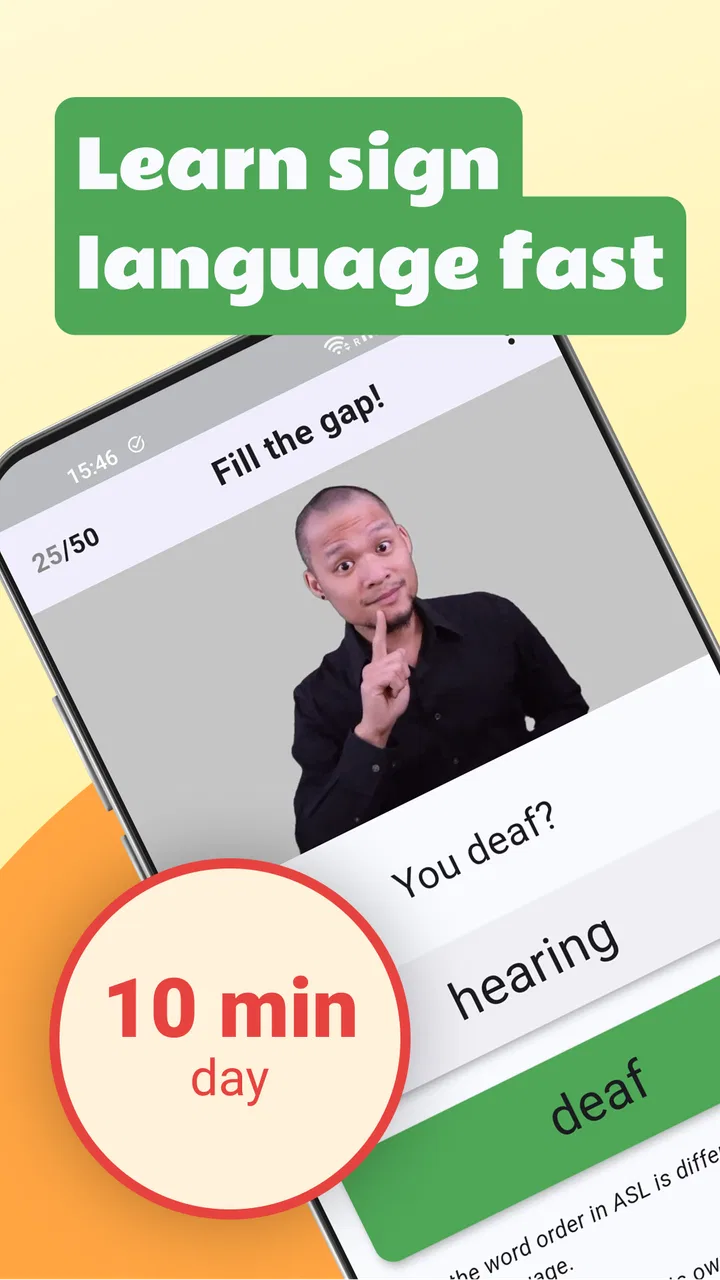
ASL - Sign Language.learn ASL! is an educational app designed to help beginners study American Sign Language through lessons, visual demonstrations, and practice activities. It introduces common signs, everyday expressions, and useful vocabulary in a more interactive format than a traditional word list. The app can be helpful for casual learners, travelers, families, or anyone who wants to begin communicating with Deaf or hard-of-hearing people.
02Is ASL - Sign Language.learn ASL! suitable for complete beginners?
Yes, the app is mainly aimed at people who are starting from the basics and do not already have extensive ASL knowledge. Its visual approach makes it easier to observe hand shapes and movements while learning frequently used signs. However, users should remember that learning individual signs is only the first step. Building real conversational ability also requires regular practice, attention to facial expressions, grammar, and interaction with experienced ASL users.
03Does the app teach complete American Sign Language grammar and conversation?
The application is useful for building vocabulary and becoming familiar with common signs, but it should not be considered a complete replacement for an ASL class or a qualified instructor. American Sign Language has its own grammar, sentence structure, facial expressions, and cultural context. Depending on the lesson content available in the version you install, the app may focus more on individual signs than on advanced conversations, regional variations, or fluent signing.
04Can I use the app without an internet connection?
Offline availability may depend on the specific version of the app, the lesson, and whether content has already been downloaded to your device. Some learning materials may work without an internet connection, while videos, updates, advertisements, or additional lessons could require access to the web. Before relying on it for travel or study away from home, open the lessons you need in advance and check which features remain accessible offline.
05Is ASL - Sign Language.learn ASL! free to download and use?
The app may be available as a free download, but free access does not always mean that every feature is included at no cost. Some versions of educational apps use advertisements, optional purchases, subscriptions, or locked premium lessons. We recommend checking the current Google Play Store or Apple App Store listing for pricing, in-app purchase details, supported devices, and the developer’s privacy information before downloading and beginning a longer study program.
Pros
- Clear lessons help beginners learn common ASL signs step by step.
- Useful visual demonstrations make hand movements easier to understand.
- Short practice sessions fit well into daily learning routines.
- Covers practical vocabulary for greetings
- numbers
- and everyday situations.
- Helpful for families
- students
- and anyone communicating with Deaf people.
Cons
- Limited content may not replace a complete ASL course or tutor.
- Some signs can vary by region
- context
- or individual signing style.
- Progress tracking and personalized feedback may be fairly basic.
- Users need a stable internet connection for some lessons or media.
- Learning isolated signs does not fully teach ASL grammar or conversation.

ASL - Sign Language.learn ASL!
Gallery